How to Avoid Bad Growth Advice (30,000+ Posts Studied)
I found a content tactic associated with 159% more views.
That sounds like a growth hack worth stealing.
Except when I compared posts from the same creators, the number dropped to 42%.
Another popular tactic averaged +38%. But for the median creator, it was −10%.
The statistics were real. The obvious advice wasn't nearly as convincing.
I discovered this while trying to grow my own app. I collected 33,300 TikTok posts, then took a closer look at 1,594 photo-format posts from 51 wedding-related accounts.
I wanted to find repeatable ways to get distribution.
What I found was a surprisingly easy way to fool yourself.
If you're trying to grow an account, here's how I'd decide which viral tactics are actually worth stealing.
1. A viral post isn't necessarily a winning post
Imagine finding a TikTok with 500,000 views.
You love the hook. The formatting is clever. You copy the whole thing.
But the creator usually gets a million views.
You just copied a post that performed below their normal baseline.
This is one of the biggest problems with studying viral content: successful creators have successful posts even when they use mediocre formats.
I saw this in my own data.
| Tactic | Across all posts | Within the same creator |
|---|---|---|
| Text on every slide | +159% | +42% |
| No final call to action | −17% | −1% |
Reported associations with views. Comparing a creator with themselves removes one source of difference; it does not turn the study into an experiment.
Same 1,594 posts. Different comparison.
Text on every slide still looked promising, but its apparent advantage was much smaller.
And the supposed penalty for skipping a call to action almost vanished.
The difference matters because large creators don't just have different formatting. They have larger audiences, established distribution, and other advantages you don't acquire by copying their slides.
The lesson: don't just study viral posts. Study posts that outperform their creator's normal content.
Open the account. Check the surrounding posts. Find out whether the tactic is actually associated with unusually good performance for that person.
It won't eliminate every bias, but it will eliminate one very common mistake.
2. An impressive average can hide a lot of failures
This was my favorite discovery.
You know those endings creators love?
"Save this for later."
"Follow for more tips."
They're easy to add, and there's a plausible reason they might help.
So I looked at posts using save/follow endings versus other posts from the same creators.
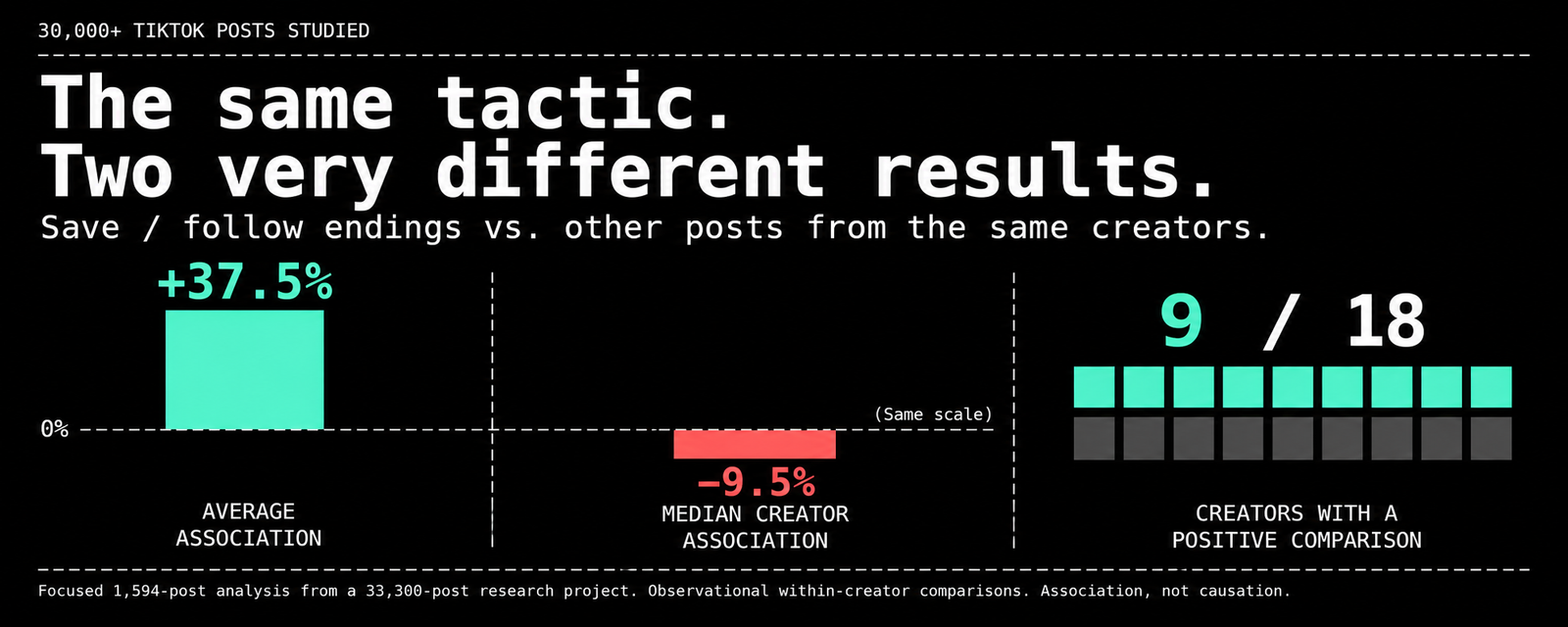
The average within-creator association with views was +37.5%.
Pretty compelling.
Until you look at the rest:
- +37.5% average association
- −9.5% median creator's association
- 9 out of 18 creators with a positive comparison
Half the eligible creators showed a positive association. Half didn't.
| Within-creator comparison | Reported result |
|---|---|
| Average association with views | +37.5% |
| Median creator’s association | −9.5% |
| Creators with a positive comparison | 9 out of 18 |
These are comparisons of existing posts, not randomized effects. A positive average does not establish that the typical creator benefits.
One creator had just two posts with save/follow endings, with a contrast exceeding +1,200% against their other posts.
A few extreme results like that can pull the average upward.
So which number should you trust?
All of them. They're describing different aspects of the same data.
But if you're deciding whether to add a save request to every post, the average alone is a terrible guide.
And remember: these were comparisons of existing posts, not experiments. A creator might use save requests on particular topics or at particular times. We can't assume the closing line caused the difference.
The conclusion isn't that save requests are bad.
It's that “+38% on average” is very different from “this reliably improves your posts.”
If adding a closing line takes 20 seconds, I'd absolutely consider testing it.
I just wouldn't rewrite my entire content strategy around that average.
3. A tactic can win on views and lose on your actual goal
There's another trap I encountered.
The data could tell me which posts received more views, saves, and shares.
It couldn't tell me which posts generated more followers or customers.
And those aren't interchangeable.
A post that gets 100,000 views and 20 followers isn't necessarily a better growth result than one that gets 20,000 views and 200 followers.
If you're trying to build an audience, you care about follows, not just views.
If you're selling something, reach can be valuable without being the final objective.
That changes which advice is worth following.
A tactic designed to maximize entertainment might be great for reach and terrible for qualified traffic. Or the reverse.
Without the relevant outcome data, you simply don't know.
The lesson: decide what success means before copying the tactic.
Otherwise you can spend weeks getting better at a metric that doesn't move your actual goal.
The quick way to audit any growth hack
You don't need 30,000 posts or a data science background to do this.
The next time you find a viral tactic worth stealing, run three checks:
- Find the baseline. Compare the post with 5–10 reasonably comparable posts from the same creator.
- Find the failures. Look for other posts using the tactic, ideally across several creators.
- Run the cheapest useful test. Choose one change and decide beforehand whether you will measure views, follows, clicks, or customers.
A cheap experiment can be worth trying before you have enough evidence to call it a reliable rule.
1. Find the baseline.
Open the creator's account. Look at 5–10 reasonably comparable posts.
Is the supposed winner actually outperforming the creator's normal content?
2. Find the failures.
Look for other posts using the same tactic, ideally across multiple creators.
Are there repeatable wins, or is the entire argument based on one huge breakout?
If you can't find enough examples, treat it as an interesting hypothesis—not a proven rule.
3. Run the cheapest useful test.
Choose one change you can make to your own content.
Test it across several reasonably comparable posts, with and without the change. Decide beforehand whether you're measuring views, follows, clicks, or customers.
Don't declare victory after one lucky post. Look for a pattern worth continuing to test. That's it.
You don't need certainty before trying something.
Especially when you're small, a cheap experiment with substantial upside can be a great bet.
But you should know the difference between a promising idea and evidence that it consistently works.
This study began while I was growing Seat Everyone, my wedding seating tool. I wanted distribution advice I could afford to act on.
I want every distribution advantage I can find, and I'm perfectly happy stealing good ideas from other people's knowing or unknowing experimentation. I just want to know what I'm actually stealing.
Copy the idea. Test the claim. Earn the confidence.